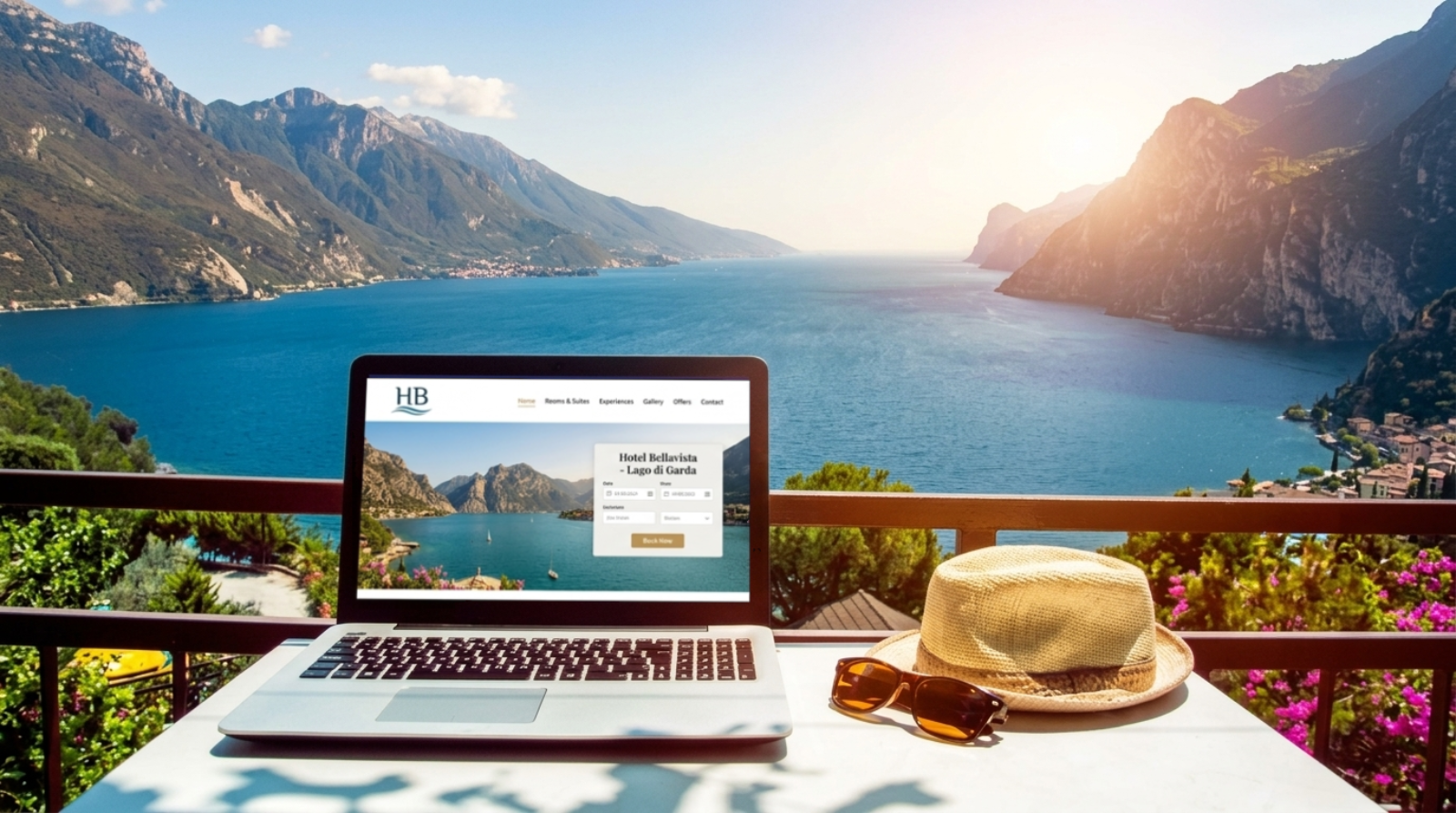
Hotel booking commissions: the calculation that tells you whether the direct channel pays back
How much OTA commissions cost in a year, how much a website that converts direct bookings costs, and how many months the second takes to cover the first
I have lost count of the times a B&B owner has shown me their Booking.com statement with a look halfway between resignation and irritation. The question that follows is always the same: "should I build a website with direct booking?". The honest answer is not yes or no. It is a calculation that depends on three numbers almost nobody lines up: how much you are already paying in commissions, how much the website you want to build costs, and how many direct bookings a month you need for the second to cover the first.
In this article I give you the method I use in my website projects for hospitality businesses, not a generic claim that "the direct channel always pays": it does not, and I would rather tell you before I sell you anything.
How much booking commissions cost in a year
Booking.com's base commission in Italy is 15% on every confirmed booking. If you join the Preferred Partner Programme, the commission goes up by 3 percentage points to 18%: in high-demand tourist areas it almost always settles at this level, whether you join the programme or not. The Preferred Partner Plus segment, reserved for the top 10% of partners in the programme, pays 23%. These figures come from material gathered by the Italian Competition Authority (AGCM) in its hearings with Federalberghi, the Italian hoteliers' federation, which fed into the March 2024 decision on the investigation opened against the platform.
Booking.com itself, on its official partner page, does not publish a single percentage: it states that the exact amount depends on the country, the type of property and the contract signed when joining, and that the increased-visibility programmes add a further share on top of the base commission. That is why the calculation I suggest starts from your real percentage, the one you find in your extranet, not from an average figure that applies to everyone.
Commissions paid in a year = OTA bookings per month × average booking value × commission percentage × 12
With an 18% commission and an average booking value of 250 euros, each OTA booking costs you 45 euros in commission alone, before VAT and before any extra costs of the programme you belong to. Over twenty bookings a month that is 900 euros a month, almost 11,000 euros a year leaving the property before it has covered a single operating cost.
What the direct channel costs instead
The direct channel is not free: it has an entry cost and a running cost, and anyone selling it to you as "no commissions, so free" is telling you only half the story. A website for a hospitality business, with SEO set up so that people already searching for your area can find it and an integrated booking engine, needs an initial investment and then recurring costs: SEO has to be maintained, and the booking engine or channel manager often comes with a monthly fee.
What many owners miss is that the cost of the website has to be compared with what it replaces, not looked at on its own. A website costing a few thousand euros looks like a significant sum until you put it next to the 11,000 euros of commissions in the example above.
Want to see the number for your own case, not a generic example?
I have built a calculator that takes your real data (OTA bookings, average value, commission, planned investment) and tells you how many direct bookings a month you need for the direct channel to pay back the investment within a year.
Open the break-even calculator (in Italian)
Working out the break-even point
The break-even point answers a precise question: how many direct bookings a month do you need for the commission you save to cover what you spend on the website and the tools that make it work (channel manager, booking engine, SEO maintenance)?
Direct bookings needed per month = (annual website investment + annual tool costs) ÷ 12 ÷ commission saved per booking
The "commission saved per booking" is the average booking value multiplied by the commission percentage you no longer pay because that booking comes from your website rather than the OTA. With an average value of 250 euros and an 18% commission, the saving is 45 euros per booking. If the annual cost of website and tools is 3,600 euros, you need 300 euros a month in savings, which means about 7 direct bookings a month to break even over the year.
Are seven direct bookings a month a realistic target? It depends on your property's total volume: if you take 30 bookings a month, that is 23% of the total, a target within reach of a well-built website. If you take 8 in all, you are asking the direct channel to become almost your only channel, and that is a different goal that takes longer to reach.
Who the direct channel works for, and who it does not
This is where I stop giving you a single rule, because there is not one. I have worked with properties on Lake Garda in very different situations, and the test I use to work out where someone stands is always the same: how much the property is already searched for by name or by area.
- Property with a strong reputation or location: if your area is already searched on Google (the name of the village, the lake, the street), an optimised website catches searches that would otherwise end up on Booking.com anyway, except that there you pay commission on something you could have had for free with SEO. Here the direct channel pays back quickly.
- New property or one with no track record: if you opened recently and nobody searches for you by name yet, a website on its own does not create traffic out of nothing. OTAs remain the most efficient acquisition channel in the early phase, because they put you in front of people already looking for a property in your area without knowing you exist. In this phase the website is needed, but as a shop window that converts people arriving from elsewhere, not as the first channel.
OTAs remain a legitimate channel. The decision is about what share of your bookings it makes sense to move to the direct channel, and sizing the website investment to that goal.
My advice: before commissioning a website, look at how many searches Google Search Console (or whatever tool you use) already records for your property's name or your area. If the number is close to zero, the problem to solve first is visibility. The website comes afterwards, when there is already something to convert.
A mistake I corrected: the website is not enough on its own
On the first project I handled for a hospitality business on Lake Garda, I had put everything into the website: careful design, an integrated booking engine, pages for every room type. Direct traffic arrived more slowly than I had expected, because SEO had been treated as a later phase rather than part of the same job. From then on I changed the order: first the content structure, built around the real searches of people looking for a property in that area, then the website built on top of that structure. It is the method I applied in the project for a B&B on Lake Garda with an SEO-optimised website, and in the brand identity and website work for Casa della Ada: the website is the final part, not the first.
What I would do in your position
If I had to decide for a property today, I would first work out the break-even point with the property's real numbers, not an industry average: things vary too much between a 4-unit holiday home and a 12-room B&B in a town centre. If the number of direct bookings needed to break even is under 15-20% of current total volume, I would invest in the website, because the target is reachable in less than a year. If the number required is over 40-50% of current volume, I would first work on basic visibility (Google listing, reviews, presence in local searches) and postpone the website investment until the property has at least some direct searches to convert.
Frequently asked questions
Is the booking commission always the same?
The percentage depends on the contract signed when joining and on any increased-visibility programmes: Booking.com does not publish a single rate that applies to everyone. The way to find your exact percentage is to check the commission statement in your extranet account.
Does a direct booking website eliminate OTA commissions completely?
No: the website reduces the share of bookings that go through OTAs, it does not eliminate them. Many properties keep a mix of direct and OTA channels even after investing in an optimised website, because OTAs keep catching people who are searching without yet knowing which property to choose.
How long does a new website take to start bringing in direct bookings?
It depends on how much the property is already searched for by name or area: if SEO is already set up well, the first effects show within a few months; if you start from zero in an area with few searches, it takes longer because visibility has to be built first.
Is it still worth staying on Booking.com with a direct website live?
For new or little-known properties, yes, because it remains an acquisition channel that brings bookings you could not reach otherwise. The right question is not whether to leave Booking.com, but what share of bookings it makes sense to move to the direct channel.
Want to know how many months a direct booking website takes to pay back for your property?
I look at your real numbers, not an industry average, and tell you whether and when the investment pays for itself.
Key takeaways
- •Booking.com charges a base commission of 15%, rising to 18% with the Preferred Partner Programme and to 23% with Preferred Partner Plus
- •The break-even point is the annual cost of the website divided by the commission saved on each booking moved to the direct channel
- •For a newly opened or little-known property, OTAs remain a useful acquisition channel: the issue is their share, not their existence
- •A direct booking website makes sense when the property already has a flow of direct searches to convert, not as its very first channel

Ekaterina Ponchak
I build websites and AI-powered web apps, and I handle SEO and digital marketing for Italian small and mid-sized businesses. I turn an online presence into real enquiries.